Paint, Stickers, and Highlighters: How Readers Are Transforming Their Books Into Personal Masterpieces
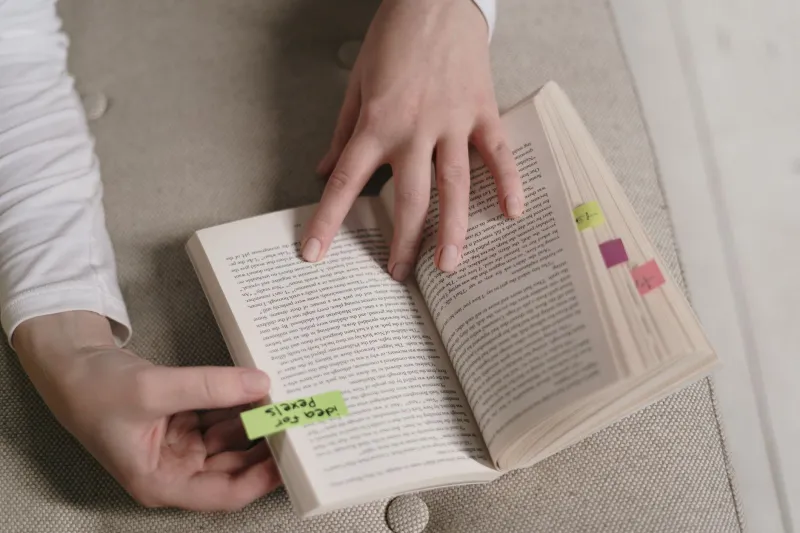
Walk into any Barnes & Noble today and you'll find something that would have baffled a librarian twenty years ago: entire display shelves dedicated not to books, but to the stuff readers put inside them. Pastel highlighter sets. Tiny adhesive tabs in fifteen colors. Stamps shaped like flowers, stars, and speech bubbles. The annotation supply market is booming, and it's telling us something pretty interesting about how Americans are choosing to experience their reading lives.
This isn't your high school English teacher's margin-note tradition. What's happening now is something altogether different — part literary engagement, part visual art project, part deeply personal ritual. Readers across the country are developing elaborate, color-coded systems for marking their books, illustrating blank spaces with tiny sketches, and layering pages with decorative tape and pressed flowers. The books they're creating look less like studied texts and more like illuminated manuscripts made by someone with a Michaels loyalty card and a lot of feelings about character development.
From Functional to Fabulous
The impulse to mark up a book has always existed. Scholars have done it for centuries — scribbling reactions, cross-referencing passages, flagging ideas worth revisiting. What's changed is the intention behind the marking. For a growing number of readers, the visual experience of the annotated page has become just as meaningful as the text itself.
Take Maya, a 29-year-old graphic designer from Austin who started color-coding her reading four years ago. She uses a six-color highlighter system: yellow for quotes she loves, blue for moments that surprise her, pink for passages about identity, green for nature imagery, orange for anything she wants to research further, and purple for lines she'd want tattooed on her arm someday. "When I finish a book," she says, "I flip back through and I can literally see what it did to me. The colors tell a story about my reading experience that I couldn't put into words."
For Maya, this isn't about preservation — it's about documentation. The book becomes a record of an encounter, a kind of emotional transcript.
The Artists Pushing It Further
Then there are the readers who've moved well past highlighters into full-on artistic territory. Jenna, a librarian and self-described "book artist" in Portland, Oregon, has been illustrating her copies of beloved novels for the past three years. She works in fine-tipped ink pens and watercolor, sketching portraits of characters in the margins, drawing maps of fictional landscapes in the endpapers, and painting small scenes from pivotal chapters onto the title page.
"I read slowly when I'm doing this," she admits. "Like, really slowly. But I also remember everything. The act of visualizing a scene well enough to draw it forces me to sit with it in a way I never did before."
Her annotated copy of Circe by Madeline Miller took her four months to finish and is now, by any reasonable measure, a one-of-a-kind art object. She's been offered money for it. She's said no every time.
This kind of deep creative engagement is showing up all over social media, particularly on BookTok and Bookstagram, where annotated pages have become their own aesthetic genre. Flat lays of heavily marked novels — pages fanned open to reveal bursts of color and tiny illustrations — rack up hundreds of thousands of views. The visual beauty of a well-annotated book has become a form of content in itself.
The Preservation vs. Personalization Debate
Not everyone is celebrating. In certain corners of the book-loving community, the sight of a painted or sticker-covered novel triggers something close to genuine distress. Collectors and bibliophiles who view books as artifacts argue that marking up a text — especially a first edition or a meaningful vintage copy — is an act of irreversible damage.
It's a fair point, and most enthusiastic annotators make a clear distinction: they're not touching their rare finds or library books. The personalization happens on their own copies, often paperbacks they've specifically purchased for the purpose of marking up.
But the philosophical tension goes deeper than physical preservation. There's a school of thought, rooted in traditional literary criticism, that argues heavy personal annotation can actually get in the way of the text — that covering a page with your own visual language risks drowning out the author's voice with your own aesthetic noise.
Jenna pushes back on this. "I think the opposite happens. When you have to translate what you're reading into a visual form, you're engaging with the author's choices more directly, not less. You have to ask yourself what something actually looks like, what a character's expression really is. That's a deeper reading, not a shallower one."
What the Research Suggests
There's some cognitive science backing up the annotators' instincts. Studies on what researchers call "elaborative encoding" suggest that connecting new information to existing knowledge — or expressing it through a different medium — significantly improves long-term retention. Drawing a concept, in other words, tends to stick it in your memory better than simply underlining it.
For readers who've always struggled to retain what they read, or who find their attention slipping during longer novels, the act of active visual annotation can serve as an anchor. It gives your hands something to do, your eyes a second layer to engage with, and your brain a creative problem to solve alongside the act of reading.
Building a System That Works for You
If you're curious about developing your own annotation practice, the community of dedicated annotators is genuinely welcoming — and full of practical advice. A few things worth knowing before you dive in:
Start with a dedicated copy. Buy a fresh paperback specifically for annotation. This removes the psychological barrier of "ruining" a book and gives you full permission to make it entirely yours.
Keep your system simple at first. A three-color highlighter system is easier to maintain consistently than a twelve-color one. You can always expand as your practice evolves.
Experiment with materials gradually. Washi tape, fine-tipped pens, and small sticker tabs are great entry points before committing to watercolors or paint markers, which require a bit more technique to use without bleeding through pages.
Don't worry about making it pretty. The most valuable annotated books aren't necessarily the most visually polished — they're the most honest. A messy, chaotic page covered in scrawled reactions and crooked doodles can be just as meaningful as a carefully composed illustration.
More Than a Trend
What's happening with annotation culture right now feels like something more durable than a social media moment. It's connected to a broader shift in how readers are thinking about their relationship with books — not as passive consumers of text, but as active collaborators in the reading experience.
A book that you've illustrated, color-coded, flagged, and filled with your own handwriting isn't just a book anymore. It's a conversation. It's evidence that you were here, that this story landed somewhere specific inside you, and that you cared enough to respond.
In an era when so much of what we consume disappears into the scroll, there's something genuinely radical about leaving a permanent, personal, beautiful mark on the things that move us. These readers aren't defacing their books. They're completing them.