One More Chapter Won't Kill You (But Your Alarm Clock Might): The Science Behind Late-Night Reading Spirals
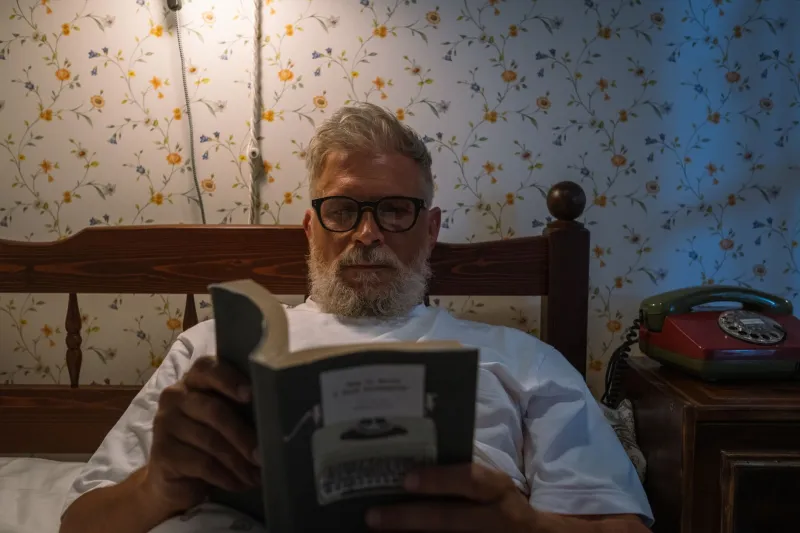
It starts innocently enough. You crawl into bed at a reasonable hour, crack open your book, and promise yourself — genuinely, sincerely promise — that you'll stop at the end of the chapter. Forty-five minutes later, the chapter ends. You flip the page anyway. Somewhere between the plot twist you didn't see coming and the cliffhanger that closes out Part Two, the clock on your nightstand has quietly become your enemy.
If this sounds familiar, you're not weak-willed or bad at adulting. You're just human — and you picked up a really good book.
Your Brain on Narrative: It's Basically a Drug
Here's the thing nobody warns you about when you fall in love with reading: your brain is genuinely not equipped to resist a compelling story. Dr. Paul Zak, a neuroeconomist at Claremont Graduate University, has spent years studying the way narratives affect brain chemistry. His research shows that emotionally engaging stories trigger the release of oxytocin — the same bonding hormone associated with trust, love, and connection. When you're deep in a novel that's working, your brain is essentially marinating in feel-good chemicals.
But it goes further than that. Unresolved narrative tension — a character in danger, a secret about to be revealed, a relationship teetering on the edge — activates your brain's dopamine reward system. Your mind starts anticipating resolution, and that anticipation feels good. Stopping before you get it feels, neurologically speaking, almost physically uncomfortable. Authors who are great at endings know this. The chapter break isn't a resting point. It's a trap.
"I kept telling myself I just needed to find out if she made it out of the house," says Danielle M., a nurse from Columbus, Ohio, who stayed up until 4 AM reading The Silent Patient on a Tuesday. "And then she did, and suddenly I needed to know something else. It never stopped."
The Zeigarnik Effect Is Not Your Friend at Midnight
Psychologists have a name for the mental itch created by unfinished tasks: the Zeigarnik Effect. First identified by Soviet psychologist Bluma Zeigarnik in the 1920s, the theory holds that the human brain remembers and fixates on incomplete experiences far more than completed ones. Applied to fiction, this means that every unresolved storyline is essentially an open loop your mind desperately wants to close.
Good authors — the ones whose books keep you up at night — are masterful open-loop architects. They layer tension upon tension, answering one question just as they plant three more. By the time you've reached midnight, your brain isn't just reading a book. It's running a background program dedicated entirely to resolving a dozen dangling narrative threads, and it will not rest until it gets at least a few of them.
Sleep researcher Dr. Michael Grandner, director of the Sleep and Health Research Program at the University of Arizona, puts it plainly: "The brain struggles to disengage from emotionally or cognitively stimulating content. A page-turner novel activates the same arousal systems that make it hard to wind down after a stressful day at work. The difference is, a stressful day feels bad. A great book feels wonderful — which makes it even harder to walk away."
The Readers Who Know Better (And Do It Anyway)
What makes the late-night reading spiral so uniquely human is that it almost always involves full self-awareness. Unlike doom-scrolling — which tends to happen in a kind of passive haze — staying up to read is usually a conscious, deliberate choice made by someone who knows exactly what they're doing and does it anyway.
Take Marcus T., a high school history teacher from Portland, Oregon. "I have a first period class that starts at 7:30," he says, laughing. "I've shown up to teach the French Revolution on maybe four hours of sleep more times than I'd like to admit. And every single time, I was completely aware of what I was choosing. I just... didn't care enough to stop."
There's something almost defiant about it. In a culture that's constantly optimizing — sleep schedules, morning routines, productivity hacks — reading past midnight feels like a small, joyful act of rebellion. You're choosing story over schedule. You're prioritizing wonder over wellness, at least for one night.
"It's the one time I'm doing something purely for myself," says Priya K., an accountant from Chicago who describes herself as a "chronic one-more-chapter offender." "The house is quiet, nobody needs anything from me, and I'm completely inside this other world. I know I'll be tired tomorrow. I genuinely don't care."
The Blue Light Myth (And the Real Problem)
For years, the conversation around nighttime reading focused heavily on blue light — the wavelengths emitted by phones and tablets that suppress melatonin production and disrupt sleep onset. Switching to physical books was often framed as the responsible, sleep-friendly alternative.
Here's the nuance nobody talks about enough: the blue light from your e-reader or phone is a factor, yes. But for most dedicated late-night readers, the bigger issue isn't the light source. It's the content itself. A physical paperback read under a warm lamp can keep you just as wired as any screen if the story is gripping enough. Cognitive and emotional arousal — the kind a genuinely great book produces — is its own sleep disruptor, independent of any device.
The light matters. But the story matters more.
So Is It Worth It?
This is the question every sleep-deprived reader asks themselves at 6:45 AM, staring at a coffee maker with the thousand-yard stare of someone who just finished a 400-page novel in one sitting.
Honestly? Sometimes, yes.
Research on what's called "bedtime procrastination" — the habit of staying up later than intended — generally frames it as a negative pattern associated with stress and poor self-regulation. But several studies have also pointed to reading as a meaningful exception. Unlike screen-based procrastination, reading before bed (even too much of it) is consistently linked to lower stress levels, greater empathy, and improved cognitive function over time. You're paying a short-term debt in sleep for what might be a long-term investment in your inner life.
That doesn't mean you should ignore your alarm clock forever. Sleep deprivation is real, cumulative, and genuinely harmful when it becomes chronic. But the occasional night where a book pulls you past midnight? That's not a failure of discipline. That's a sign you found something worth staying up for.
"I finished Demon Copperhead at 3 AM on a Wednesday," recalls Janelle R., a librarian from Nashville. "I sat there in the dark for like ten minutes afterward just... feeling it. Then I went to sleep. I was exhausted the next day. It was completely worth it."
A Few Honest Tips (From One Reader to Another)
If you want to protect your sleep without giving up the joy of late-night reading entirely, a few things actually help. Setting a physical timer — not just a mental note — creates a real interruption that's harder to ignore than willpower alone. Reading in a chair instead of bed builds a psychological separation between story-time and sleep-time. And choosing a natural break point, like the end of a part or a section rather than a chapter, gives your brain a slightly more satisfying stopping place.
But let's be real. If the book is good enough, none of that will matter. You'll read one more chapter anyway.
And honestly? We get it. That's kind of the whole point.