Something Happens to Your Brain at 1 AM With a Book in Your Hands
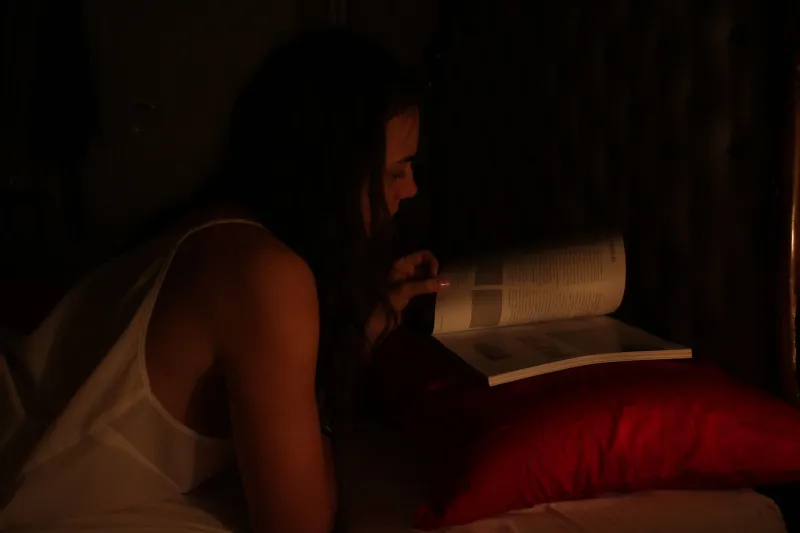
You know the feeling. Everyone in the house is asleep. The notifications have finally gone quiet. There's a lamp throwing a small warm circle of light, and you're three chapters deeper into a book than you meant to be. The story feels uncomfortably close — like it's talking directly to you, about you, in a way it somehow didn't during your lunch break read.
That's not your imagination. That's your brain doing something genuinely different.
Your Defenses Come Down After Dark
During the day, your mind is basically working a second job. It's managing to-do lists, replaying conversations, bracing for the next thing on the calendar. Psychologists call this cognitive load, and it's the invisible wall standing between you and full emotional immersion in a story.
Late at night, that wall gets a lot shorter.
Dr. Shelby Harris, a behavioral sleep medicine specialist, has written extensively about how the brain transitions in the evening hours. As the body prepares for sleep, the prefrontal cortex — the part responsible for logic, skepticism, and self-monitoring — gradually loosens its grip. What's left is a mind that's more emotionally open, more associative, and significantly less guarded.
For readers, that loosened grip is everything. The same paragraph that felt like pleasant prose at 2 PM can feel like a gut punch at 1 AM, not because the words changed, but because you changed. Your brain is primed to feel things more acutely and filter them less aggressively.
Silence Is Doing More Work Than You Think
There's a concept in sensory psychology called "signal-to-noise ratio," and it applies to reading in a surprisingly literal way. During the day, your senses are constantly processing background input — traffic, voices, screens, movement. Even when that noise doesn't consciously distract you, it's dividing your attention in tiny increments.
Night strips most of that away.
What researchers have found is that in quieter, lower-stimulation environments, readers achieve something closer to what cognitive scientist Maryanne Wolf calls "deep reading" — a state where the brain isn't just decoding words but actively building mental imagery, emotional simulation, and narrative prediction. It's immersive in a way that skimming a page between meetings simply isn't.
This is why night readers consistently describe their experiences in more intense terms. "I felt like I was inside the book," is a phrase you'll hear again and again from people who stay up too late with a story they can't put down. That's not hyperbole. That's deep reading doing exactly what it's supposed to do.
The Loneliness That Isn't Lonely
There's something else happening at midnight that's harder to quantify but just as real: the particular texture of solitude.
Marcus Webb, a 38-year-old high school teacher from Portland, Oregon, has been a committed late-night reader since college. "Daytime reading always feels like I'm stealing time from something else," he says. "At night, the world has basically given me permission to just exist with a book. There's nobody waiting on me."
That permission matters psychologically. Literary psychologists who study reader-text relationships have noted that when readers feel unobserved and unhurried, they're more likely to pause, reflect, and emotionally invest in characters. The self-consciousness that makes us skim — the sense that reading is somehow indulgent — evaporates when the rest of the world is unconscious.
Night reading, in other words, creates the conditions for genuine intimacy with a story.
Jamila Osei, a librarian in Atlanta who runs a late-night reading group called "After Hours Pages," has watched this dynamic play out in her community for years. "People will tell me they cried at a passage they'd read before without feeling anything," she says. "Same book, same words. But they read it at midnight and it landed completely differently. I stopped being surprised by that a long time ago."
The Dark Has an Atmosphere, and It's Not Nothing
There's also something to be said for the physical environment itself. Darkness narrows your visual field, and when your eyes aren't processing a wide, busy room, your brain allocates more resources to whatever it is focused on. Researchers studying attention have found that reduced ambient light correlates with increased focus on close-range tasks — which is exactly what reading is.
Add in the fact that cooler nighttime temperatures (or the warmth of blankets against that cool air) activate comfort responses in the nervous system, and you've got a sensory setup that's almost engineered for absorption.
Readers often describe nighttime reading spaces in almost sacred terms. The lamp. The quiet. The stillness. That's not just aesthetics — it's a carefully tuned environment for getting lost.
The Flip Side Nobody Talks About
It's worth being honest: late-night reading comes with a catch, and sleep scientists will be the first to remind you of it.
The same neurological openness that makes midnight reading feel profound can also make distressing content hit significantly harder. Horror, grief narratives, books dealing with trauma — these genres carry extra weight after dark, and not always in a productive way. Some devoted night readers have learned the hard way that certain books are better saved for daylight.
There's also the small matter of sleep disruption. Reading itself isn't the problem — in fact, physical books before bed are widely recommended by sleep specialists as a wind-down tool. But the "one more chapter" spiral that night reading reliably produces can push bedtime into genuinely problematic territory. The immersion that makes late-night reading so rewarding is also what makes it nearly impossible to stop.
Why Night Readers Keep Coming Back
Ask devoted late-night readers why they do it, and they rarely mention practicality. They don't say it's the only time they have free, even when that's technically true. What they say is that it feels different. That the books feel more real. That the characters feel like company in a specific way that daytime reading doesn't quite replicate.
What they're describing, whether they know it or not, is a brain that's stopped multitasking, a body that's physically relaxed, a sensory environment stripped of competition, and a self that's temporarily off the clock from the performance of daily life.
That's not a small thing. That's the ideal reading state. And for a lot of people, the only reliable path to it runs straight through midnight.
So the next time you're still awake at 1 AM because a book won't let you go — don't feel guilty about it. Your brain is doing exactly what it was built to do. It just needed the rest of the world to quiet down first.