Your Neighbor Left You a Book Last Night and Didn't Even Knock
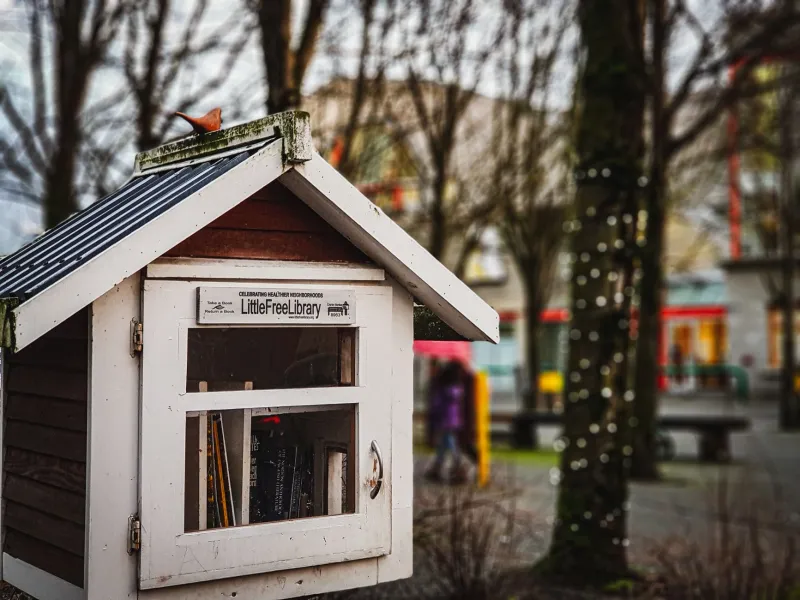
Somewhere on a tree-lined street in Portland, Oregon, a retired schoolteacher named Gloria checks her handmade cabinet every morning before she even makes coffee. It's painted robin's-egg blue, mounted on a cedar post, and stocked with whatever she finished reading that week. By noon, half the books are gone. By evening, new ones have appeared — titles she's never heard of, left by people she may never meet. She calls it her "porch library." Her neighbors just call it their favorite part of the block.
This is what a quiet revolution looks like.
A Movement That Started With One Box and a Big Idea
The Little Free Library concept officially launched in 2009 when Todd Bol of Hudson, Wisconsin, built a small schoolhouse-shaped box in honor of his late mother, a devoted reader and teacher. He mounted it in his front yard, filled it with books, and watched his neighborhood transform — one conversation, one borrowed novel, one unexpected connection at a time. The nonprofit organization that grew from that single cabinet now counts over 175,000 registered libraries in more than 115 countries. But the real number is almost certainly higher, because thousands of informal book boxes exist entirely off the grid, unregistered, unnamed, and quietly beloved.
In the United States alone, you can find them on suburban cul-de-sacs, outside apartment buildings in Brooklyn, tucked into community gardens in Austin, and bolted to fence posts in rural Mississippi towns where the nearest bookstore is a forty-minute drive. They show up in places where people need them most, placed there by people who just decided to do something.
The Secret Life of a Book Box
What makes these little libraries so fascinating isn't just the books — it's the invisible social network they create. People who've lived on the same street for years and never exchanged more than a wave suddenly find themselves bonding over a shared copy of The Nightingale or debating whether the latest thriller someone left was actually worth reading. There's something disarming about an anonymous gift. Nobody's asking for your email address or your opinion. You just take what you want and leave something behind if you feel like it.
In Chicago's Logan Square neighborhood, a group of residents started what they call a "seed library" — a Little Free Library stocked not just with books but with handwritten reading recommendations tucked inside the covers. Regulars started leaving notes in response. What began as a box of donated paperbacks turned into an ongoing, anonymous literary conversation that's been running for three years.
That kind of organic magic is hard to manufacture and impossible to predict. It just happens, over and over, in neighborhoods across the country.
The Most Creative Installations You'll Want to Visit
Not all Little Free Libraries are plain wooden boxes, and some of the most creative installations have become genuine neighborhood landmarks.
In New Orleans' Tremé district, one homeowner converted an old upright piano into a sprawling book exchange, its hollowed-out interior shelved with paperbacks organized by mood rather than genre. Signs on the keys read things like "Need a Cry" and "Need a Laugh."
Outside a Victorian home in San Francisco's Mission District, a miniature replica of the house itself serves as the neighborhood's book drop — same paint color, same gingerbread trim, even a tiny working lamp that glows at night so people can browse after dark.
In rural Vermont, a family converted an old red phone booth into a year-round book exchange that doubles as a warming station in winter — insulated shelves, a battery-powered light, and a note that reads: "Stay as long as you need to."
These aren't just cute photo opportunities (though they absolutely are that). They're expressions of personality, of care, of someone saying: this street is worth investing in.
Who's Actually Using These Things?
The short answer is: everyone. Kids grabbing picture books on the way home from school. Retirees swapping cozy mysteries. College students hunting for free textbooks or cheap entertainment between semesters. Parents looking for something — anything — to get their teenagers off their phones for an hour.
But Little Free Libraries have also quietly become lifelines in communities where access to books is genuinely limited. In neighborhoods without nearby public libraries or bookstores, a well-stocked street box can be a kid's primary access point to reading material. Several urban nonprofits have started intentionally seeding libraries in book deserts — areas where children have limited or no access to age-appropriate books at home. The impact, researchers have found, is measurable. Kids who have consistent access to books, even informal access, read more. Full stop.
The Unwritten Rules of the Book Exchange
Every regular user of a Little Free Library knows there's an unspoken etiquette at play. You don't take everything. You try to leave something. You don't dump your unwanted textbooks from 2003 or seventeen copies of the same self-help book that didn't actually help. You think about the next person.
It's a social contract that nobody signed but almost everyone honors — which, if you think about it, is kind of remarkable. In an era when online discourse can feel relentlessly adversarial, these tiny book boxes operate on pure good faith. People are, it turns out, pretty decent when given the chance to be.
Some communities have taken the etiquette further, creating neighborhood Facebook groups or Nextdoor threads to coordinate what's in their local box — flagging when something good shows up, requesting specific titles, organizing seasonal restocks. The physical box becomes the anchor for a broader digital community. The book is the excuse. The connection is the point.
How to Start Your Own (It's Easier Than You Think)
If this is making you want to build something, good. You don't need a woodworking degree or a big budget. The Little Free Library nonprofit's website offers free design plans, stewardship guides, and a registration process that puts your box on their global map. Basic builds can be done for under fifty dollars with reclaimed materials. Kits are available if you'd rather skip the sawdust.
The more important investment is intention. Think about where you live, who your neighbors are, what they might love to read. Stock your library with that in mind. A box full of books you'd actually recommend is worth ten boxes filled with whatever you needed to get out of your garage.
And then just wait. Leave the door open — literally — and see what happens.
One Page at a Time
There's something deeply fitting about the fact that books, which have always been about connection — between reader and writer, between past and present, between one human experience and another — are now literally connecting neighbors to each other through small wooden boxes on sidewalks across America.
Gloria in Portland doesn't know who took her copy of Educated last Tuesday. She doesn't know who left the dog-eared spy novel that appeared in its place. But she knows someone was there, someone browsed, someone made a choice. And tomorrow morning, before the coffee's done brewing, she'll go check again.
That's the thing about Little Free Libraries. They turn a street into a story. And every page tells you a little more about the people you live beside.