Why Your Local Bookstore Might Be the Best Therapy You're Not Paying For
Some people go to the gym when things get hard. Some people call their mom. Some people drive around with the windows down and the music up.
And then there are the people who walk into a bookstore.
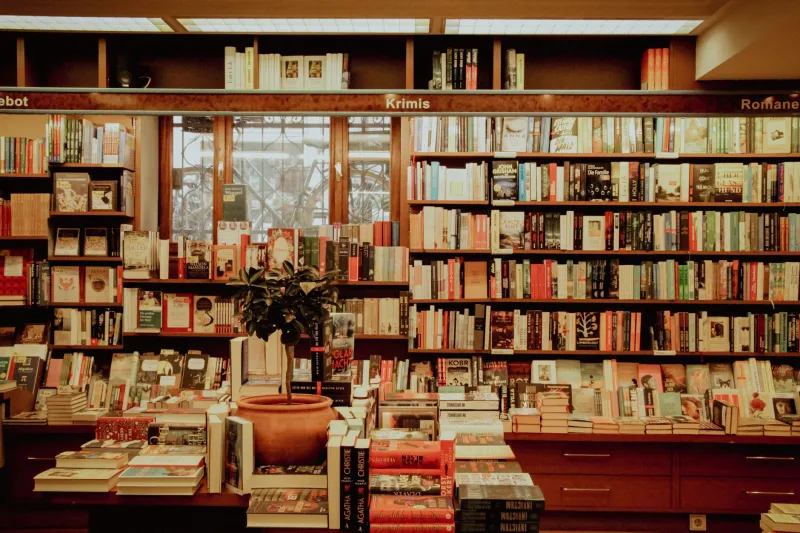
Not necessarily to buy anything. Not with a specific title in mind. Just to be somewhere quiet, somewhere that smells like paper and possibility, somewhere that asks almost nothing of them except that they look and maybe wonder. For a growing number of Americans, that experience isn't just pleasant — it's necessary.
Call it bookstore therapy. It doesn't have a clinical name, and you won't find it in any treatment protocol. But talk to independent bookstore owners across the country and you'll hear the same stories over and over: customers who come in stressed and leave calm, regulars who show up during hard weeks the way others might show up at a bar, people who say — without any apparent embarrassment — that browsing the shelves is the only thing that makes them feel like themselves.
The Sensory Case for Browsing
There's a reason online book shopping, for all its convenience, doesn't quite scratch the same itch. Clicking through a digital catalog is efficient. Walking through a well-curated independent bookstore is something else entirely.
The sensory experience is a big part of it. The smell of books — that distinctive combination of paper, ink, and whatever the store has absorbed over years of foot traffic — is genuinely mood-altering for many people. Research on olfactory memory suggests that scent is one of the most powerful triggers for emotional states, and for lifelong readers, the smell of a bookstore is deeply wired to feelings of safety, curiosity, and pleasure.
Then there's the tactile element: the weight of a book in your hand, the texture of a cover, the particular sound a spine makes when you open it for the first time. These are small things, but they accumulate. They pull you out of your head and into your body in a way that a screen simply cannot replicate.
"I tell people it's grounding," says Dana, a licensed therapist in Seattle who recommends bookstore visits to some of her clients. "When someone is stuck in an anxiety spiral or feeling disconnected from themselves, I sometimes suggest they go somewhere that engages their senses gently and without demand. A bookstore fits that description almost perfectly."
She's careful to note that it's not a substitute for professional care. But as a complement to therapy, or as a low-stakes act of self-regulation, she finds it genuinely useful.
What Bookstore Owners Are Seeing
Ask the people behind the counter and they'll tell you they've known this for years.
"We're not just selling books," says the owner of a beloved independent shop in Nashville that's been operating for over a decade. "We're selling a place to land. People come in here when they've had a bad day at work, when they're going through a divorce, when they just need somewhere to exist for a little while that isn't their apartment or their phone."
She's learned to read her regulars. Some want to chat; others want to be left completely alone to wander. The good indie bookstore, she says, is skilled at offering both — a kind of social warmth that doesn't demand anything, a community that accepts you whether you buy something or not.
That last part matters more than it might seem. In a world where almost every public space is optimized for transaction, a bookstore that lets you linger without pressure is genuinely countercultural. You can spend forty-five minutes reading the first chapters of three different books, put them all back on the shelf, and leave. Nobody will follow you with a push notification.
The Pause That Browsing Creates
There's a concept in psychology sometimes called "soft fascination" — the gentle, low-effort engagement that happens when you're in a pleasant environment without a specific task. Walking in a park does it. So does sitting near water. And, for readers, so does wandering through a bookstore.
Unlike the sharp focus required to answer emails or scroll through social media, soft fascination allows the mind to rest while staying lightly engaged. It's restorative rather than depleting. And in an era of near-constant cognitive demand, that kind of mental ease is increasingly rare and increasingly valuable.
"I go to the bookstore the way other people go to church," says James, a high school teacher in Philadelphia who visits his local independent shop most Saturday mornings. "It's a ritual. It resets me. I usually buy something, but honestly, the buying is almost secondary. What I'm really there for is the hour I spend not thinking about anything except what I might want to read next."
That framing — the bookstore as ritual, as reset — comes up again and again in conversations with regular customers. There's something about the intentionality of the visit, the act of physically going somewhere dedicated to stories and ideas, that feels meaningful in a way that convenience can't replicate.
Serendipity as Medicine
One of the quieter gifts of the independent bookstore is the discovery you didn't know you needed. Unlike an algorithm that feeds you more of what you already like, a well-organized bookstore has the capacity to surprise you — to put something in your path that opens a door you didn't know was there.
That serendipity has its own therapeutic quality. It's a reminder that the world is larger than your current preoccupations, that there are stories and ideas out there you haven't encountered yet, that curiosity is still alive in you even on the days when it feels buried.
Here at iReadPages, we believe that every page tells a story — and so does every bookstore visit. The next time life feels like too much, consider this: your nearest independent bookshop might be closer than your therapist's office, and the cover charge is just the willingness to walk through the door.